A cooling decision
is a compute decision.
Load shifts and cooling disruptions can propagate across a facility. The research question: how can operators see those interactions early enough to evaluate a response?
Connect the physical
and the possible.
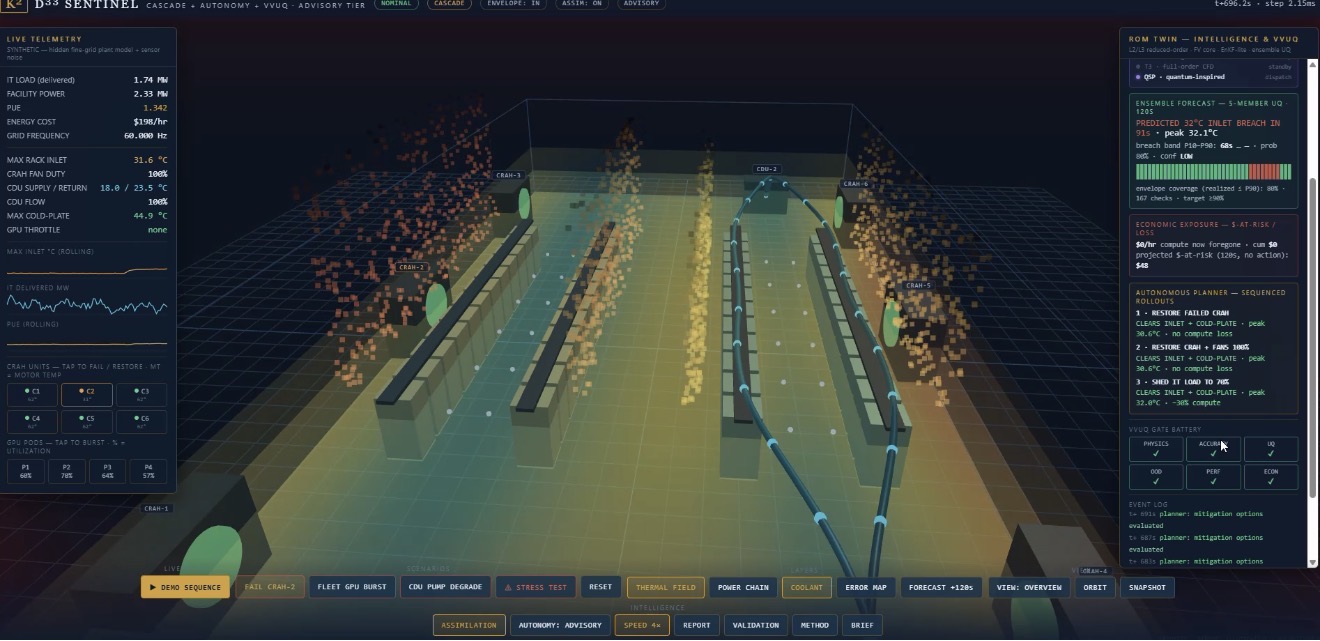
Bring sensor-ready inputs, 3D simulation, and AI-assisted scenario analysis into a digital triplet that makes power and cooling tradeoffs easier to investigate.
Better visibility.
More informed action.
Compare operating scenarios, inspect thermal constraints, and explore interventions before applying them to a physical environment.
Change a condition.
See the relationship.
At this load and flow, the simplified loop remains below the illustrative return-temperature limit.
Model assumptions
Steady-state heat balance: temperature rise = heat load ÷ (mass flow × specific heat). Water specific heat is held at 4.18 kJ/(kg·K). The 35°C return limit is selected for this demonstration. This simplified illustration excludes transients, losses, heat-exchanger performance, and equipment controls; it is not a facility operating recommendation.